

What are the fire risks associated with lithium-ion batteries?
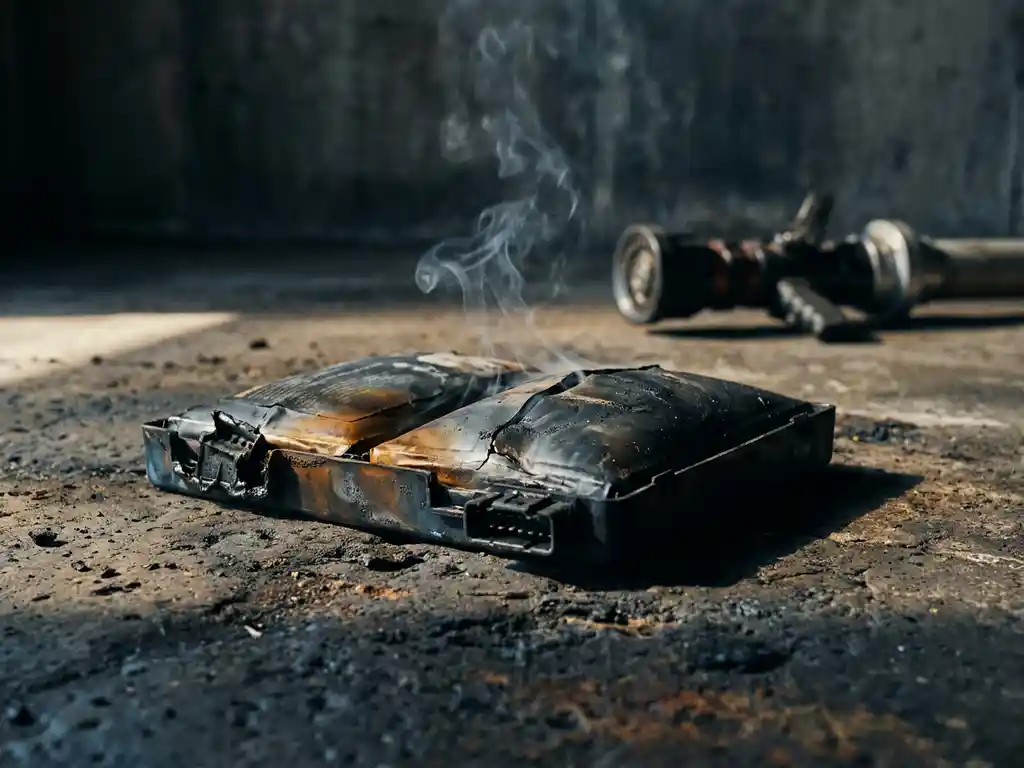
Lithium-ion batteries pose serious fire risks primarily because of a self-accelerating chemical reaction called thermal runaway, which can cause cells to ignite, explode, or release toxic gases with little warning. These fires burn at extreme temperatures, are difficult to extinguish with conventional methods, and can reignite hours after they appear to be out. The sections below unpack the key questions around lithium-ion battery fire risks, from what triggers them to how they can be detected and suppressed before they cause major damage.
How does thermal runaway cause lithium-ion battery fires?
Thermal runaway is a chain reaction inside a lithium-ion cell where rising temperature causes further heat generation, which in turn raises the temperature further, until the cell reaches a point of uncontrolled failure. Once triggered, the process is largely self-sustaining and can spread from one cell to adjacent cells within a battery pack in a matter of seconds or minutes.
Inside a lithium-ion cell, heat breaks down the separator between the anode and cathode. When that barrier fails, internal short circuits generate enormous amounts of heat. The electrolyte, which is a flammable organic solvent, vaporizes and can ignite. The chemical decomposition of the cathode material also releases oxygen internally, feeding combustion even in the absence of external air. This combination of fuel, heat, and internally generated oxygen makes thermal runaway exceptionally difficult to interrupt once it begins.
The danger is compounded in battery packs where cells are arranged in close proximity. Heat from one failing cell transfers to its neighbors, triggering a cascade of failures across the entire pack. In large-scale systems such as Battery Energy Storage Systems, this cascading effect can turn a single faulty cell into a catastrophic fire event.
What conditions trigger a lithium-ion battery fire?
Lithium-ion battery fires are most commonly triggered by overcharging, physical damage, manufacturing defects, external heat exposure, or deep discharge followed by rapid recharging. Any condition that causes a cell to generate more heat than it can safely dissipate creates the conditions for thermal runaway.
- Overcharging: Forcing more energy into a cell than its chemistry can handle causes lithium plating on the anode and generates excess heat.
- Physical damage: Punctures, crushing, or deformation can breach the internal separator and cause an immediate short circuit.
- Manufacturing defects: Microscopic impurities or flaws in the separator can cause internal short circuits that develop slowly over time.
- Thermal stress: Exposure to high ambient temperatures accelerates chemical degradation inside cells and reduces the margin before thermal runaway occurs.
- Deep discharge and rapid recharge: Repeatedly draining a cell below its minimum voltage and then recharging it quickly stresses the cell chemistry and increases the risk of internal failure.
- Aging: As lithium-ion cells age, internal resistance increases, generating more heat during normal charge and discharge cycles.
In industrial and commercial settings, inadequate battery management systems, poor ventilation around battery enclosures, and improper installation are among the most preventable contributing factors to li-ion battery hazards.
Why are lithium-ion battery fires harder to extinguish than conventional fires?
Lithium-ion battery fires are harder to extinguish than conventional fires because the cells generate their own oxygen through chemical decomposition, meaning the fire does not depend on an external air supply. Cutting off oxygen, which is effective against most fires, has limited impact when the fuel source is self-oxidizing.
Water can cool cells and slow the spread of thermal runaway, but it does not stop the underlying chemical reaction. Large volumes of water are typically needed, and even after apparent extinguishment, cells can retain enough internal heat to reignite hours or even days later. This reignition risk makes lithium-ion battery fires a particular challenge for fire responders and facility managers alike.
Conventional dry powder or CO2 extinguishers are largely ineffective against battery fires because they address the flame rather than the root cause. Foam agents can suppress surface flames but do not penetrate the cell structure where the reaction is occurring. The self-sustaining nature of thermal runaway means that suppression efforts must focus on interrupting the heat cycle and preventing cell-to-cell propagation rather than simply smothering the visible fire.
What toxic gases are released during a lithium-ion battery fire?
During a lithium-ion battery fire, cells release a mixture of toxic and flammable gases including hydrogen fluoride, carbon monoxide, hydrogen cyanide, and various volatile organic compounds. Hydrogen fluoride is among the most hazardous, as even brief exposure to low concentrations can cause severe respiratory damage and chemical burns.
The exact composition of gases depends on the cathode chemistry of the battery. Cells using lithium cobalt oxide, lithium nickel manganese cobalt oxide, or lithium iron phosphate each produce somewhat different gas profiles, but all release compounds that are dangerous to human health and corrosive to nearby equipment and infrastructure.
Beyond the immediate health risk to people in the vicinity, these gases can cause secondary damage to electronics, structural materials, and ventilation systems throughout a facility. In enclosed spaces such as server rooms, battery storage vaults, or switchgear rooms, the rapid accumulation of toxic gases makes early detection and rapid suppression critically important for both personnel safety and asset protection.
Which environments face the highest lithium-ion battery fire risk?
Environments with the highest lithium-ion battery fire risk are those where large numbers of cells are stored or operated in close proximity, where thermal management is challenging, or where a fire would have severe operational consequences. Battery Energy Storage Systems, data centers, electric vehicle charging infrastructure, and industrial switchgear rooms are among the highest-risk environments.
Battery Energy Storage Systems (BESS)
BESS installations concentrate large numbers of high-capacity lithium-ion cells in enclosed enclosures, often with limited ventilation and significant thermal load. A single cell failure in a poorly managed system can propagate rapidly across an entire battery rack. The scale of energy stored means that a BESS fire can be exceptionally difficult to control and can result in prolonged outages with major financial and operational consequences.
Data centers and ICT infrastructure
Data centers increasingly rely on lithium-ion UPS batteries as backup power sources. These batteries operate in warm, densely packed environments alongside sensitive and expensive electronic equipment. A fire in a server room or ICT cabinet not only destroys the battery itself but also risks damaging irreplaceable hardware, causing data loss, and triggering extended downtime across connected systems.
Industrial and high-voltage cabinets
Switchgear and high-voltage electrical cabinets often incorporate battery-backed control systems. These environments combine electrical ignition risks with the specific hazards of lithium-ion chemistry, creating a compounded fire risk that standard cabinet fire protection may not adequately address.
How can lithium-ion battery fires be detected and suppressed early?
Lithium-ion battery fires can be detected early through aspirating smoke detection systems, which sample air from inside enclosures and identify combustion particles before visible smoke or flame develops. Early suppression using inert gas agents, particularly nitrogen, can then interrupt thermal runaway at the cell level before it spreads to neighboring cells or the wider environment.
Aspirating detection is particularly well-suited to battery environments because it detects the early off-gassing that precedes full thermal runaway, giving suppression systems time to act before a fire becomes uncontrollable. Conventional heat or smoke detectors mounted outside an enclosure typically respond too late to prevent significant damage.
For suppression, inert gases such as nitrogen are effective because they reduce oxygen concentration within the enclosure without leaving chemical residues that could further damage sensitive electronics. Unlike water or foam, nitrogen does not create secondary contamination or corrosion risks, which is a critical consideration in environments housing high-value equipment. The key is combining detection and suppression in an integrated system that responds automatically at the object level, close to the source of the fire, rather than relying solely on room-level suppression systems that activate after significant damage has already occurred.
How ExxFire helps protect against lithium-ion battery fire risks
ExxFire offers integrated fire detection and suppression systems purpose-built for the environments most exposed to lithium-ion battery fire risks. The systems combine aspirating smoke detection with non-pressurized nitrogen gas suppression, delivering a fast, clean, and residue-free response at the object level before thermal runaway can spread.
- Early aspirating smoke detection identifies combustion particles inside enclosures before visible fire develops
- Non-pressurized nitrogen gas suppression interrupts thermal runaway without leaving chemical residues or damaging sensitive electronics
- Systems are designed for BESS enclosures, server racks, switchgear cabinets, and high-voltage installations
- PFAS-free technology replaces legacy gas suppression agents with a cleaner, environmentally responsible alternative
- Easy self-installation with no ongoing maintenance requirements and built-in relay reporting to existing fire panels
- Tested and certified by CNPP France and DMT, part of TÜV Nord
For organizations that cannot afford the downtime, hardware loss, or safety exposure that a lithium-ion battery fire creates, early and reliable protection at the source is essential. Explore ExxFire’s solutions to find the right fire detection and suppression system for your critical assets.
Related Articles
- How do you document and review a fire risk assessment?
- How does poor electrical wiring increase fire risk?
- What certifications should a fire suppression system have in 2026?
- What are the differences between water mist and inert gas fire suppression?
- How do PFAS restrictions impact fire protection planning in 2026?