
What is the difference between clean agent and conventional fire suppression?
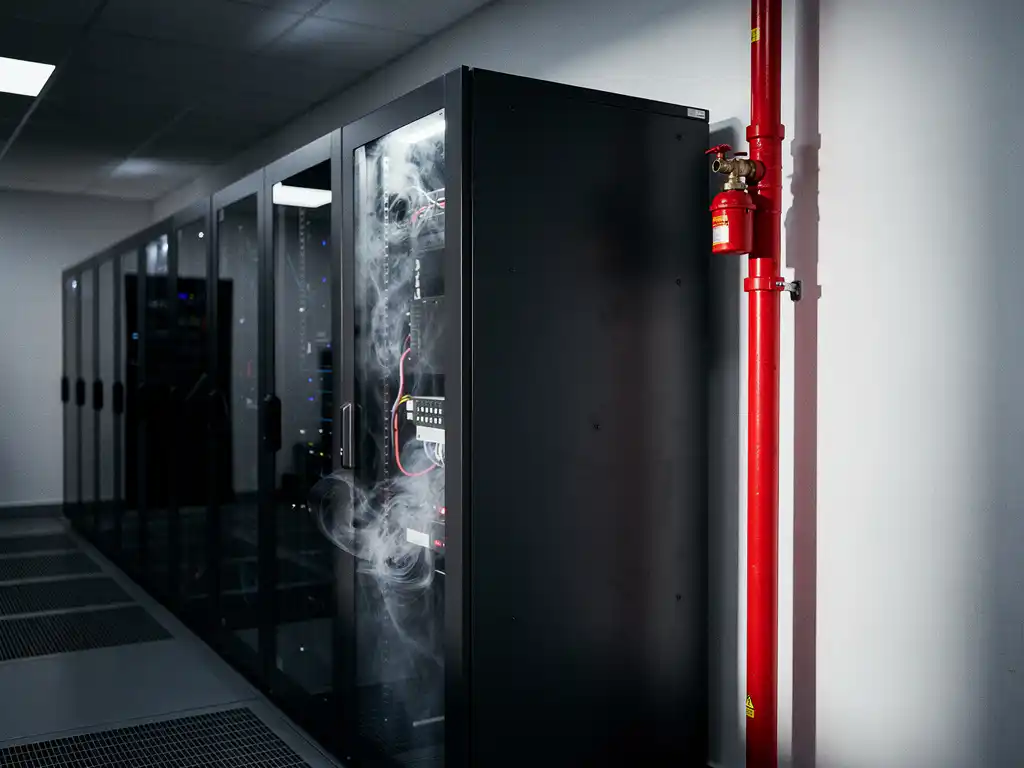
Clean agent fire suppression systems use gaseous or chemical agents that extinguish fire without leaving residue, water, or foam behind, making them safe for sensitive equipment and occupied spaces. Conventional fire suppression systems, by contrast, rely on water sprinklers, foam, or dry chemical powders that can cause as much secondary damage as the fire itself. The key difference comes down to what happens after the system activates: clean agents leave equipment intact and operational, while conventional systems often require extensive cleanup and replacement. The sections below unpack how each system works, where each belongs, and how to choose the right approach for your environment.
How does a clean agent fire suppression system actually work?
A clean agent fire suppression system detects a fire in its earliest stage and discharges a gaseous suppression agent that removes heat, oxygen, or free radicals from the combustion process. The agent disperses evenly within an enclosed space, extinguishes the fire rapidly, and then dissipates without leaving any residue on equipment, surfaces, or components.
The most widely used clean agents fall into two categories: halocarbon agents, which interrupt the chemical chain reaction of combustion, and inert gas agents, which reduce the oxygen concentration in a protected space below the level needed to sustain a fire. Inert gas agents such as nitrogen, argon, or blends of the two work purely through physical means, with no chemical byproducts involved.
Modern clean agent systems typically integrate smoke detection directly into the suppression unit. Aspirating smoke detectors continuously sample the air within a protected enclosure, identifying combustion particles at concentrations far too low for conventional detectors to register. This early detection capability means the system can respond before a fire develops beyond its incipient stage, dramatically reducing the risk of hardware damage or downtime.
What are the main types of conventional fire suppression systems?
Conventional fire suppression systems are those that use water, foam, or dry chemical agents to extinguish fire. The most common types include wet pipe sprinkler systems, dry pipe sprinkler systems, deluge systems, foam suppression systems, and dry chemical or dry powder systems. Each type is designed for specific fire classes and occupancy types.
Wet pipe sprinklers are the most widely installed system globally. They keep water under constant pressure in the pipes, releasing it automatically when a sprinkler head is triggered by heat. Dry pipe systems replace the pressurized water with compressed air or nitrogen, releasing water only after the air pressure drops, which makes them suitable for spaces where pipes could freeze.
Deluge systems discharge water simultaneously across an entire protected zone and are typically used in high-hazard industrial environments such as aircraft hangars or chemical storage areas. Foam suppression systems are common in fuel storage and aviation applications, where a blanket of foam smothers flammable liquid fires. Dry chemical systems discharge a fine powder that interrupts the combustion chain reaction and are often used in commercial kitchens or vehicle engine bays.
Why are conventional systems considered damaging to sensitive equipment?
Conventional fire suppression systems cause significant secondary damage to sensitive equipment because water, foam, and dry chemical agents are highly corrosive, conductive, or physically destructive when they contact electronics, precision machinery, or stored data. In many cases, the suppression agent causes more total damage than the fire would have if left unchecked for the same duration.
Water is electrically conductive and immediately shorts out powered electronics. Even after drying, water leaves mineral deposits and promotes corrosion on circuit boards, connectors, and mechanical components. Server racks, switchgear cabinets, and battery systems that are hit by a sprinkler discharge typically require complete replacement rather than repair.
Dry chemical powders present a different but equally serious problem. The fine particles penetrate every gap and crevice in an enclosure, coating contacts and components with a residue that is difficult to remove completely. Even after professional cleaning, residual powder continues to cause corrosion and electrical faults over time. Foam systems introduce similar contamination risks and add the complication of liquid infiltration into sealed enclosures.
Beyond the immediate equipment damage, conventional systems trigger extended downtime. A data center or industrial facility that activates a sprinkler system faces not only hardware replacement costs but also the time required to dry out the space, assess damage, procure replacement equipment, and restore operations. For mission-critical environments, this downtime can be far more costly than the hardware itself.
Which environments are best suited for clean agent suppression?
Clean agent fire suppression is best suited for enclosed environments housing high-value electronics, sensitive equipment, irreplaceable data, or assets that cannot tolerate water or chemical contamination. This includes data centers, server rooms, electrical switchgear cabinets, ICT enclosures, telecommunications infrastructure, battery energy storage systems, and medical or laboratory environments.
Any space where a conventional suppression discharge would cause unacceptable secondary damage is a strong candidate for clean agent protection. This is especially true for environments that operate continuously and cannot absorb extended downtime, such as financial trading infrastructure, hospital systems, or industrial control networks.
Clean agent systems are also well suited to occupied spaces where the suppression agent must be safe for people present during a discharge. Inert gas agents, when properly designed to maintain safe oxygen levels above 12%, allow occupants to evacuate without exposure to toxic byproducts. Halocarbon agents are similarly rated for use in occupied spaces at design concentrations.
Environments where clean agent suppression is less appropriate include large open spaces with high air exchange rates, outdoor installations, and areas with very high fire loads involving solid combustibles. In these cases, the agent may not reach or maintain the concentration needed to suppress the fire effectively.
What are the environmental differences between clean agents and conventional systems?
The environmental impact of clean agent fire suppression varies significantly depending on the agent type. Inert gas agents such as nitrogen and argon have no global warming potential and no ozone depletion potential, making them the most environmentally neutral option available. Many halocarbon agents, by contrast, carry measurable global warming potential and some are subject to regulatory phase-down under environmental legislation.
Conventional systems carry their own environmental concerns. Foam suppression systems historically relied on PFAS-containing compounds, a group of synthetic chemicals that persist indefinitely in the environment and have been linked to significant ecological and human health risks. Regulatory pressure in Europe, North America, and elsewhere is now driving the phase-out of PFAS-containing foams, creating urgent demand for cleaner alternatives across industries that previously depended on them.
Water-based systems have a lower direct environmental footprint but generate contaminated runoff when activated in industrial or chemical environments. Dry chemical systems create particulate waste that requires careful disposal. In contrast, a well-designed inert gas system using nitrogen discharges a naturally occurring gas that disperses harmlessly into the atmosphere, leaving no chemical residue, no contaminated runoff, and no disposal challenge.
For organizations with sustainability commitments or compliance obligations around PFAS, the choice of suppression agent is increasingly a regulatory and reputational consideration, not just a technical one.
When should a business choose clean agent suppression over conventional?
A business should choose clean agent suppression over conventional systems when the cost of secondary damage from water, foam, or powder would exceed the value of using a simpler system, or when the protected environment cannot tolerate downtime. If the assets at risk are electronics, data infrastructure, high-voltage equipment, or battery systems, clean agent suppression is almost always the more cost-effective choice when total cost of ownership is considered.
The decision becomes straightforward when any of the following conditions apply:
- The protected space contains electronics, servers, switchgear, or battery systems that would be destroyed or severely damaged by water or chemical agents
- Operational continuity is critical and even short periods of downtime carry significant financial or safety consequences
- The organization has sustainability obligations or is replacing legacy systems that contain PFAS compounds
- The protected enclosure is relatively small and sealed, making it well suited to the concentration-based suppression mechanism that clean agents rely on
- Regulatory or insurance requirements mandate a suppression method that does not introduce additional contamination risk
Conventional systems remain appropriate for general building protection, large open spaces, and environments where fire loads involve ordinary combustibles and the assets at risk are not sensitive to water or chemical exposure. The two approaches are not mutually exclusive: many facilities use building-wide conventional sprinkler systems for structural protection while deploying clean agent suppression inside specific high-value enclosures for asset-level protection.
How ExxFire protects sensitive equipment with clean agent suppression
ExxFire delivers a fully integrated approach to clean agent fire suppression for mission-critical enclosures, combining early smoke detection with fast-acting inert gas discharge in a single pre-engineered system. The solution is built around nitrogen, the most environmentally neutral suppression agent available, stored in a non-pressurized solid state using ExxFire’s patented Cool Gas Generator technology. Key features of the ExxFire system include:
- Aspirating smoke detection that continuously samples air inside the enclosure and identifies combustion particles at the earliest possible stage, before a fire develops into a damaging event
- PFAS-free nitrogen suppression that extinguishes fire without leaving chemical residue, protecting sensitive electronics, battery systems, and switchgear from secondary damage
- Non-pressurized storage that eliminates the safety and maintenance concerns associated with pressurized gas cylinders, reducing total cost of ownership over the system’s lifetime
- Self-installation without special certification, making deployment straightforward for facility managers and ICT infrastructure teams
- Built-in relay outputs for integration with existing fire panels, ensuring the system fits within established safety infrastructure
- Testing and certification by CNPP France and TÜV Nord, providing verified performance assurance for compliance-driven procurement
ExxFire systems are designed for closed enclosures up to 4.5 m³, with multiple units interconnectable for larger volumes, covering server racks, electrical cabinets, BESS installations, and telecom enclosures. If your organization is evaluating fire suppression for electronics or looking to replace a PFAS-containing legacy system with a cleaner, certified alternative, contact ExxFire to discuss the right configuration for your environment.