
Why are data centers switching to green fire suppression systems?
Data centers are switching to green fire suppression systems primarily because traditional chemical-based agents pose growing regulatory, environmental, and operational risks that modern facilities can no longer ignore. Stricter PFAS legislation, sustainability mandates, and the need to protect sensitive electronics without causing secondary damage are pushing operators toward cleaner alternatives. The sections below unpack the key questions driving this shift.
What is driving data centers to replace traditional fire suppression systems?
Data centers are replacing traditional fire suppression systems because legacy chemical agents, particularly those containing PFAS compounds, are facing regulatory bans across Europe and North America, while also posing real risks of damaging the very equipment they are meant to protect. The combination of tightening environmental legislation, sustainability goals, and the operational cost of chemical-related equipment damage is making the case for change impossible to ignore.
For years, halon and its successors, including many hydrofluorocarbon-based agents, were the default choice for data center fire protection. But halon was phased out under the Montreal Protocol, and its replacements are now under similar scrutiny. The European Union’s PFAS restrictions are expanding, and many of the fluorinated compounds used in traditional suppression agents fall within the scope of these regulations. Facilities that have not yet transitioned face both compliance risks and reputational exposure.
Beyond regulation, there is a straightforward operational argument. Chemical suppression agents can leave residues that corrode circuit boards, contaminate cooling systems, and render hardware unrecoverable. In a data center where a single rack can represent hundreds of thousands of euros in equipment, a suppression discharge that saves the building but destroys the servers is a poor outcome. Operators are increasingly demanding systems that suppress fire at the source without introducing a second wave of damage.
What makes a fire suppression system ‘green’ in a data center context?
A green fire suppression system is one that uses non-toxic, chemically inert agents that leave no residue, have no global warming potential, and are free from PFAS or other persistent pollutants. In a data center context, this means systems that can discharge safely around sensitive electronics without causing chemical contamination, while also meeting environmental compliance requirements.
The term sustainable fire suppression covers several distinct criteria. A system qualifies as environmentally friendly when it satisfies most or all of the following:
- PFAS-free formulation: No per- or polyfluoroalkyl substances that persist in the environment and accumulate in living organisms
- Zero ozone depletion potential: The agent does not contribute to stratospheric ozone damage
- Low or zero global warming potential: The agent does not function as a greenhouse gas if released
- No toxic decomposition products: When exposed to fire or heat, the agent does not produce harmful byproducts
- No residue after discharge: Equipment remains clean and operational after suppression, avoiding secondary damage
Inert gases such as nitrogen, argon, and carbon dioxide meet most of these criteria naturally, since they are atmospheric gases with no chemical reactivity. Among these, nitrogen stands out for data center applications because it is non-conductive, leaves absolutely no residue, and is abundant enough to make the technology cost-effective at scale.
How does nitrogen-based fire suppression work in a data center?
Nitrogen-based fire suppression works by reducing the oxygen concentration inside a protected enclosure to a level where combustion cannot be sustained, typically below 15%, while remaining safe for any personnel who may be present. Because nitrogen makes up roughly 78% of normal air, it is a naturally inert, non-toxic agent that extinguishes fire without chemical reaction and without leaving any residue on equipment.
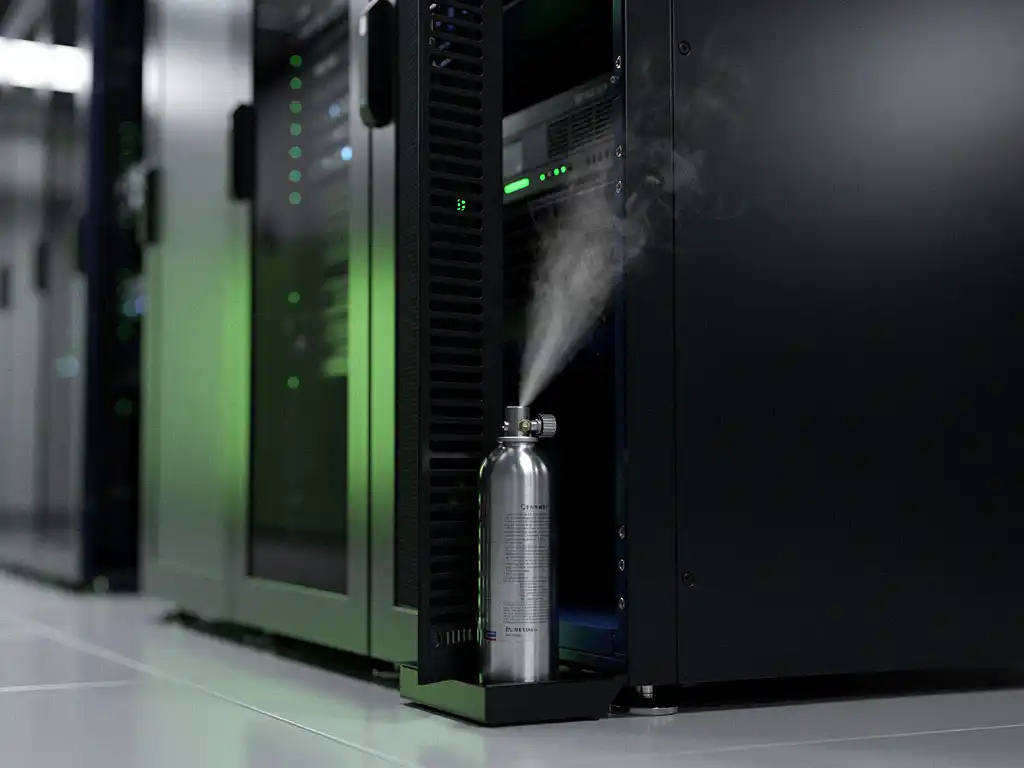
In a data center setting, nitrogen suppression is most effective when applied at the object level, meaning directly inside server racks, electrical cabinets, or battery enclosures rather than flooding an entire room. This targeted approach is more efficient, requires less agent, and ensures that suppression happens close to the actual fire source before heat and smoke spread to adjacent systems.
Modern nitrogen suppression systems integrate early smoke detection, often through aspirating smoke detection technology that draws air samples continuously and identifies combustion particles at the earliest possible stage. When smoke is detected, the system triggers the release of nitrogen into the enclosed space, displacing oxygen and stopping the fire before it can escalate. Because the nitrogen is stored in a non-pressurized solid state in advanced systems, there is no risk of accidental discharge due to pressure vessel failure, and maintenance requirements are significantly lower than with pressurized cylinder-based systems.
What’s the difference between gaseous suppression systems and traditional sprinkler or chemical agents?
The key difference is that gaseous suppression systems extinguish fire by modifying the atmosphere inside a protected space, either by displacing oxygen or interrupting the chemical chain reaction of combustion, while sprinklers use water and chemical agents use reactive compounds that leave physical residues. For data centers, this distinction is critical because water and chemical residues can destroy electronic equipment even after a fire is extinguished.
Water-based sprinkler systems
Sprinkler systems are the most common fire suppression method in commercial buildings, but they are poorly suited to data center environments. Water conducts electricity, causes immediate short-circuit damage to active hardware, and creates long-term corrosion problems. A sprinkler activation in a server room typically renders the affected equipment unrecoverable, even if the fire itself was minor. Recovery time and hardware replacement costs can be enormous.
Chemical suppression agents
Chemical agents such as FM-200 and Novec 1230 were developed as halon replacements and work by interrupting the combustion chain reaction. While effective, many of these agents contain or are derived from fluorinated compounds that fall under PFAS classification. Beyond the regulatory risk, some agents produce toxic decomposition products when exposed to high heat, and residue from discharge can contaminate sensitive components. Their global warming potential, though lower than halon, remains a concern for sustainability-focused operators.
Inert gaseous systems
Inert gas systems, including nitrogen-based solutions, work purely physically, reducing oxygen to a level that cannot sustain combustion. They produce no chemical byproducts, leave no residue, and have no global warming potential. The trade-off is that they require the protected space to be reasonably well-sealed to maintain reduced oxygen levels long enough to extinguish the fire, which is why object-level or enclosure-level application is often more practical than room-flooding approaches in active data center environments.
Are green fire suppression systems compliant with data center safety standards?
Yes, green fire suppression systems, including nitrogen-based inert gas systems, can fully comply with data center safety standards when they are independently tested and certified by recognized bodies. Compliance depends on the specific system design, the testing methodology applied, and the relevant national or international standards in the jurisdiction where the data center operates.
Key standards relevant to data center fire suppression include EN 15004 (gaseous fire-extinguishing systems in Europe), ISO 14520 (international standard for gaseous systems), and NFPA 2001 (clean agent fire extinguishing systems in North America). Inert gas systems, including nitrogen, are explicitly recognized within these frameworks as acceptable suppression methods for environments containing sensitive electronics.
Independent third-party certification is the most reliable indicator of compliance. Testing by bodies such as CNPP in France or DMT Dortmund, part of TÜV Nord in Germany, validates that a system performs as specified under real fire conditions and meets the relevant safety thresholds. When evaluating a system, data center operators should request full test documentation and verify that the certification covers the specific enclosure types and volumes in their facility.
What should data center operators consider when switching to a green suppression system?
Data center operators switching to a green fire suppression system should evaluate enclosure suitability, integration with existing fire panels, certification credentials, total cost of ownership, and ease of installation and maintenance. A well-chosen system should suppress fire at the object level, integrate seamlessly into current infrastructure, and require minimal disruption to ongoing operations during installation.
The most important considerations include:
- Enclosure compatibility: Confirm that the system is designed for the specific cabinet types and volumes in your facility, whether server racks, switchgear, battery enclosures, or telecom cabinets
- Detection speed: Early smoke detection, ideally aspirating detection that samples air continuously, is essential to catching fires before they escalate
- Integration with existing fire panels: The system should be able to report status and alarms to your current building management or fire alarm infrastructure without requiring a full infrastructure replacement
- Certification and testing documentation: Independent third-party test reports from recognized bodies provide objective evidence that the system works as claimed
- PFAS-free confirmation: Request explicit documentation that the suppression agent contains no PFAS compounds, particularly as regulations continue to tighten
- Total cost of ownership: Factor in installation complexity, maintenance intervals, agent refill costs, and the cost of any specialist certification required for installation or servicing
Operators should also consider whether the system can scale. A modular design that allows multiple units to be interconnected to protect larger volumes offers more flexibility as infrastructure grows or changes.
How ExxFire helps data centers transition to sustainable fire suppression
ExxFire provides data centers with a complete, integrated solution for green fire suppression that combines early smoke detection with nitrogen-based suppression in a single, pre-engineered system. Designed specifically for closed enclosures such as server racks and electrical cabinets, ExxFire’s systems address the full range of considerations that data center operators face when making the switch to environmentally friendly fire protection.
Key features of ExxFire’s approach include:
- PFAS-free nitrogen suppression: ExxFire’s patented Cool Gas Generator technology uses non-pressurized stored nitrogen, leaving no chemical residue and posing no risk to sensitive electronics or the environment
- Integrated aspirating smoke detection: The combined system detects combustion at the earliest possible stage and triggers suppression before fire can spread beyond the source enclosure
- Easy self-installation: Systems are pre-engineered and do not require special certification to install, reducing deployment costs and minimizing operational disruption
- Fire panel compatibility: Built-in relays allow the system to report status to an existing fire panel, ensuring seamless integration with current infrastructure
- Scalable design: Multiple units can be interconnected to protect enclosures up to 4.5 m³ and beyond, adapting to different rack configurations and cabinet sizes
- Independent certification: Systems are tested and certified by CNPP in France and DMT Dortmund, part of TÜV Nord, providing documented proof of performance
If your data center is evaluating a transition away from chemical or PFAS-containing suppression systems, contact ExxFire to discuss which configuration best fits your enclosure types, infrastructure, and compliance requirements.
Related Articles
- How do European fire safety standards apply to imported equipment?
- Why is early fire detection critical in electrical cabinet protection?
- What are the fire prevention requirements for rental properties in 2026?
- Are chemical fire suppression agents being phased out in Europe?
- What are the key sustainability certifications for fire suppression systems?